
News - Publications
Comparative analysis: European Global Health Strategies
Learning from the COVID-19 pandemic, adopting a global approach to health policymaking is central. Global health strategies are far from…

Boniface Hlabano, programme manager at Amref Health Africa, reminded the audience that vaccines work mainly by creating herd immunity but if they are stockpiled in the global north while outbreaks spread in Africa, we all lose. He pointed to the mpox outbreak in central Africa as an example in which Global North nations had stockpiled mpox vaccines while the virus spread rapidly elsewhere. This pointed to the need to have vaccines available at the source of the problem, with strong health systems ready to intervene quickly.
Hlabano also highlighted recent viral haemorrhagic fever deaths in Ethiopia as another example of why we need surveillance, timely treatment, and rapid community engagement, not just to protect Africa but the broader global community. He stressed the urgency of building manufacturing capacity on the African continent, with failure to do so meaning it will remain difficult to access countermeasures.
Dr. Abdi Mahamoud, Director – Health Emergency Alert and Response Operations (EOP), WHO Health Emergencies Programme (WHE), hailed the recent Pandemic Agreement as a generational achievement, but warned that sudden cuts to official development assistance (ODA) are a direct security risk, pointing out that it just takes one passenger on a flight to bring a pathogen to a new country. While countries like Kenya, Nigeria, and South Africa are allocating extra budgets, a 40 percent drop in ODA in 2025 is a major shock. Dr Mahamoud stressed the need to move from dependency to joint leadership and domestic financing. The funding cuts now make that transition harder, not easier.
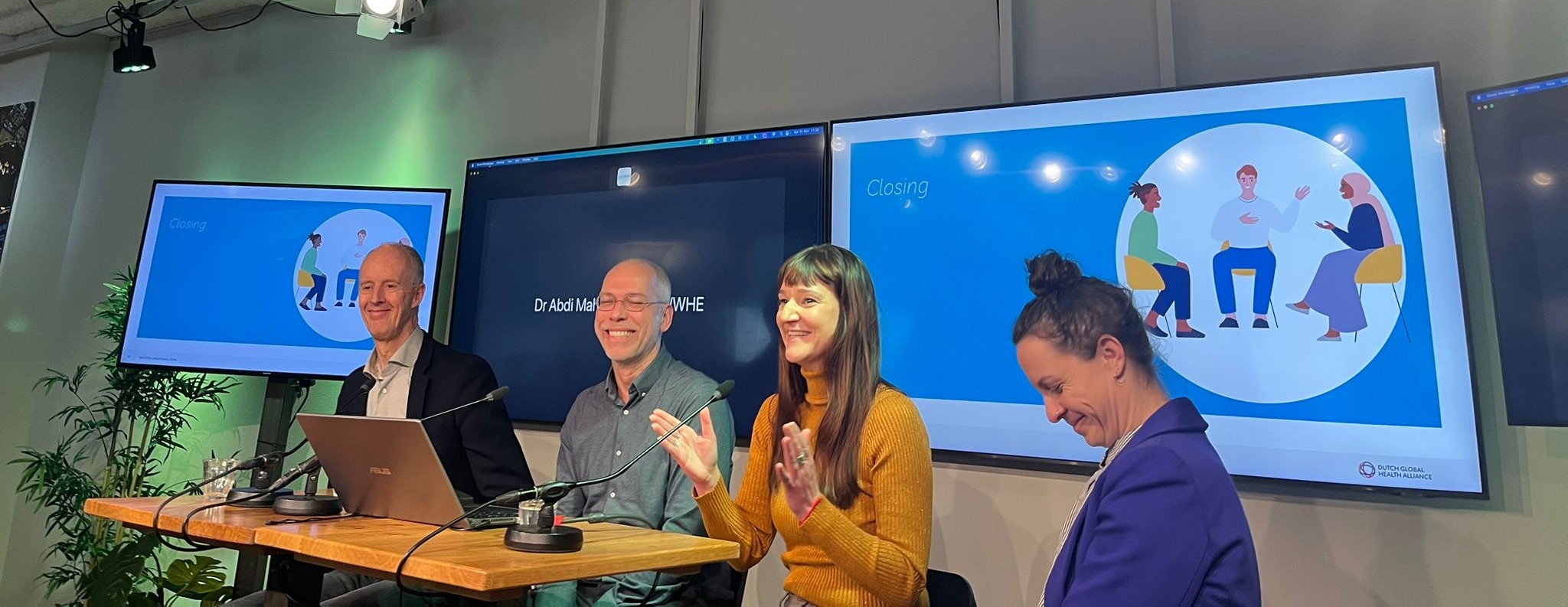
Kees Matthijssen, Mark van Passel, Sarah Dobbe, and Julia Lukomnik.
Kees Matthijssen, Lieutenant General (retired) and advisor to the Principles for Peace Foundation and the Atlantic Commission, spoke from his experience in conflict zones where he saw there was no basic healthcare, leading to the growth of instability. For him, health care is a stabilising force and helps connect communities, therefore security actors must collaborate with health actors.
Mark van Passel, Senior Policy Advisor – Directorate of International Affairs, Ministry of Health, Welfare and Sport (VWS), emphasised that Dutch health security depends on strong systems abroad because we are not insulated from global health threats. Yet, the overseas surveillance programmes we rely on to assess health in the Netherlands are under pressure. Van Passel noted that global problems require global solutions and that solidarity is also self-interest.
Sarah Dobbe, Member of Parliament representing the Socialist Party (SP), urged the Dutch government to critically examine its own role in global conflicts and health security.
She also warned about the rise of well-funded global anti-rights movements using anti-rights narratives to target health systems — for example, HIV/AIDS care. This is a threat that needs to be acknowledged and consideration should be given to what the Dutch government can do to counter it.
Dobbe concluded with a sharp critique of Dutch aid policy, suggesting that cuts to ODA ignore a basic truth: global health security collapses if poorer countries are left without resources.
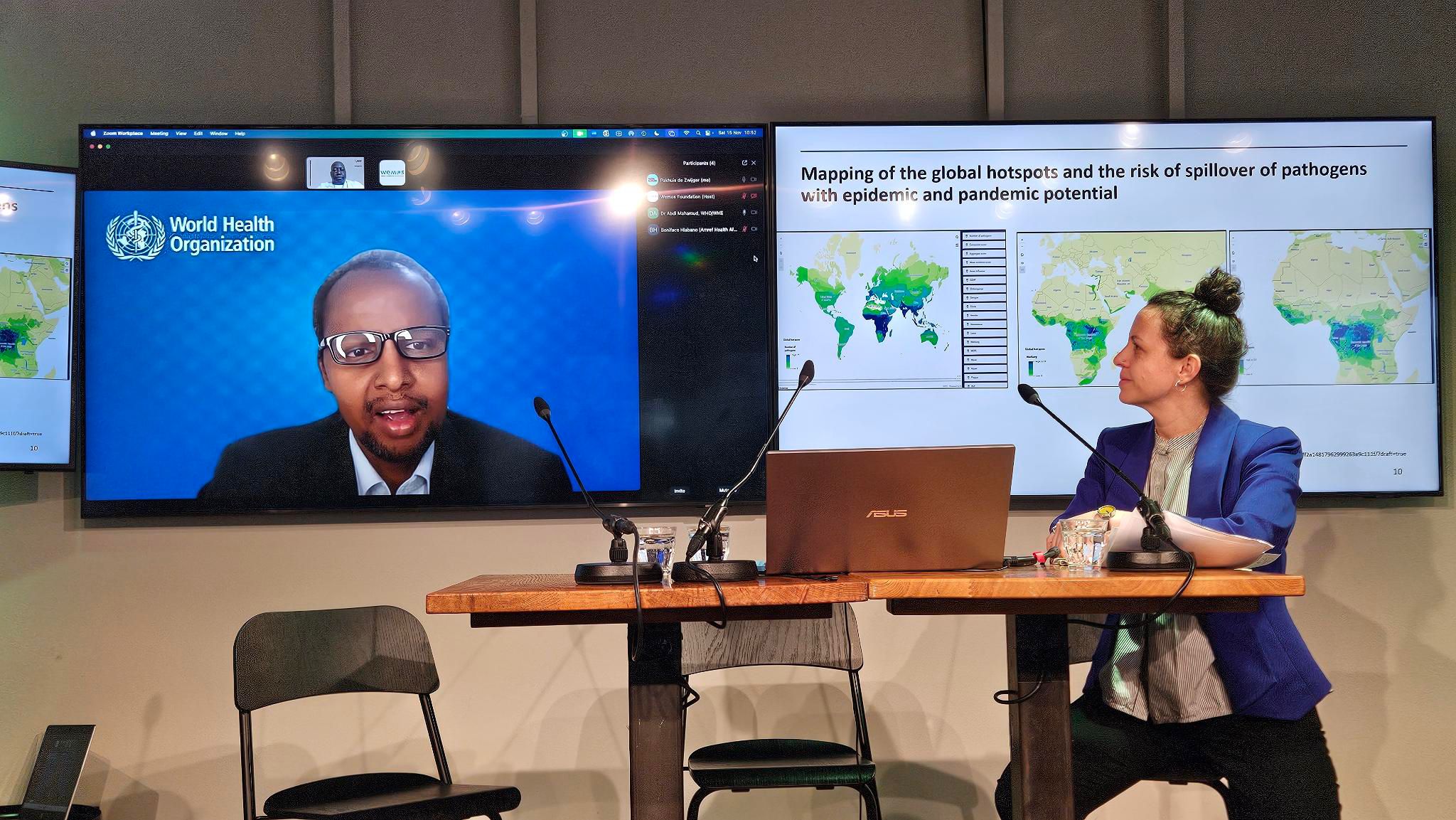
Dr. Abdi Mahamoud and Julia Lukomnik.
Julia Lukomnik, Strategic Advisor at Aidsfonds and moderator of the session, summed up the consistent message across the session: global health security only works when we invest where outbreaks begin. Budget cuts and vaccine nationalism only weaken our defenses. To make progress, we must keep investing now, so that aid dependency can give way to joint leadership and shared responsibility. That is the path to resilience and shared security. The world is too interconnected for any country to stay safe alone.
Watch the session
Afrikadag (Africa Day) is the largest public event on Africa and international cooperation in the Netherlands. Each year it is organised by the Foundation for European Progressive Studies (FEPS) and the Foundation Max van der Stoel (FMS). Learn more at www.afrikadag.nl.
"*" indicates required fields